Creating a consistent publishing strategy becomes much easier when you use Google Sheets content calendar templates. Instead of guessing what to post and when, you get a structured system that keeps your content organized, searchable, and performance-driven.
Today, creators, marketers, and businesses rely on content calendars to plan blogs, social media posts, and SEO campaigns. Whether you use Notion, Google Sheets, Excel, or Etsy templates, the goal is the same: better planning = better results.
In this guide, you’ll explore the best tools, templates, and strategies to build a powerful content system that actually helps you grow.
A strong content system is not just about planning—it’s also about scaling your SEO and content operations efficiently. Many marketers even combine planning with advanced SEO services to grow faster and save time.
If you want to scale content creation like an agency, white label seo services can help you manage SEO tasks, backlinks, and content at a professional level without doing everything manually.
What are Google Sheets content calendar templates?
Google Sheets content calendars are pre-built spreadsheets used to plan, organize, and schedule content across blogs and social media. They help creators track publishing dates, keywords, and performance in one place, making content planning more structured and efficient for SEO and marketing growth.
A content calendar usually includes:
- Publishing dates
- Content topics or keywords
- Platforms (blog, Instagram, YouTube, etc.)
- Status (planned, in progress, published)
- Performance tracking
For marketers, it acts like a content roadmap that connects strategy with execution.
Key Benefits of Using a Content Calendar for Social Media & Blogging
A strong content calendar improves both consistency and performance.
Here are the main benefits:
1. Better Consistency
You avoid random posting and maintain a steady content flow, which is important for SEO and audience trust.
2. Improved Time Management
Batch planning saves hours every week by organizing content in advance.
3. Strong SEO Strategy
With Google Sheets content calendar templates, you can align content with keywords and search intent.
Keyword alignment is only one part of a strong SEO strategy. To truly rank higher, your content also needs proper on-page optimization, internal linking, and structure improvements.
A detailed understanding of on page seo guide helps you optimize headings, keywords, and content flow so your calendar-driven strategy actually converts into rankings.
4. Team Collaboration
Teams can easily track who is responsible for what content.
5. Performance Tracking
You can analyze which content performs best and improve future planning.
Content Calendar Templates for Notion (Complete Guide)
Notion is a popular all-in-one workspace used for content planning, databases, and team collaboration.
It allows creators to build visual dashboards for content workflows.
You can create:
- Blog editorial calendars
- Social media planners
- SEO content trackers
Notion templates are highly customizable and support drag-and-drop organization, making them ideal for creative teams.
Why Notion is a Powerful Tool for Content Planning & Management?
Notion is powerful because it combines multiple tools into one system.
Unlike spreadsheets, it offers:
- Visual database views (calendar, board, table)
- Easy linking between content ideas and tasks
- Real-time collaboration
- Custom templates for workflows
For creators who prefer visual organization over spreadsheets, Notion is a strong alternative to Google Sheets s.
Best Free & Paid Notion Content Calendar Templates (Features + Use Cases)
Notion templates vary based on usage:
Free Templates
- Basic content planners
- Simple editorial calendars
- Personal blogging trackers
Paid Templates
- Advanced marketing dashboards
- SEO content pipelines
- Social media automation systems
Use cases include:
- Freelance bloggers managing posts
- Agencies handling multiple clients
- YouTubers planning scripts and uploads
Content Calendar Templates for Google Sheets & Excel (Most Popular Choice)
Google Sheets and Excel remain the most widely used tools for content planning because they are:
- Easy to use
- Free (Google Sheets)
- Highly flexible
- Compatible with teams
Most Google Sheets content calendar templates are built for:
- Social media scheduling
- Blog publishing plans
- SEO keyword tracking
- Campaign management
Excel is preferred in corporate environments, while Sheets is popular among freelancers and online marketers.
Why Google Sheets & Excel Are Still the Best Content Planning Tools?
Despite modern tools like Notion and AI platforms, spreadsheets are still dominant.
Here’s why:
1. Simplicity
No learning curve—anyone can start immediately.
2. Flexibility
You can design your own structure without limitations.
3. Automation Support
Google Sheets supports formulas, integrations, and API connections.
4. SEO-Friendly Planning
You can track:
- Keywords
- Titles
- URLs
- Traffic performance
This makes Google Sheets content ideal for SEO professionals.
Best Google Sheets Content Calendar Templates for 2026
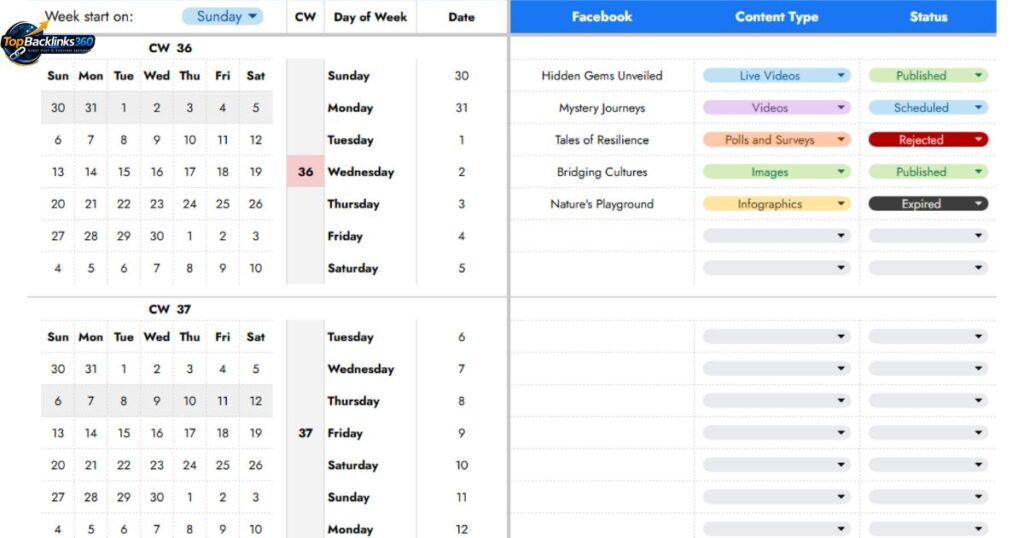
Here are the most effective types of templates:
1. Monthly Content Planner
Used for long-term planning of blogs and campaigns.
2. Social Media Calendar
Tracks daily posts across Instagram, Facebook, TikTok, and LinkedIn.
3. SEO Content Calendar
Focuses on keywords, search intent, and blog publishing schedules.
4. Automated Content Calendar
Connected with tools that update content status automatically.
These templates help creators maintain a structured publishing system without confusion.
Best Excel Content Calendar Templates for Advanced Users
Excel templates are ideal for advanced users who need:
- Data analysis
- Reporting dashboards
- Performance tracking
Common Excel content calendars include:
- Marketing performance trackers
- Campaign ROI dashboards
- Multi-channel planning sheets
Excel is especially useful for agencies handling large-scale content operations.
Etsy Content Calendar Templates (Digital Products Overview)
Etsy offers a wide range of ready-made content calendar templates.
These are usually:
- Designed for instant download
- Aesthetic and visually structured
- Easy to use for beginners
Many creators sell:
- Social media planners
- Blogging calendars
- Business content dashboards
These templates are popular among freelancers and small business owners.
Popular Social Media Content Calendar Templates on Etsy (What You Get + Use Cases)
Etsy templates typically include:
- Monthly posting schedules
- Hashtag planners
- Content idea banks
- Platform-specific layouts
Use cases:
- Instagram content planning
- YouTube upload schedules
- TikTok growth strategy planning
They are especially helpful for users who want ready-made systems instead of building Google Sheets from scratch.
How to Choose the Best Content Calendar Template for Your Needs?
Choosing the right template depends on your goals.
For Beginners:
- Google Sheets templates
- Simple Notion dashboards
For Marketers:
- SEO-focused spreadsheets
- Campaign tracking systems
For Agencies:
- Advanced Excel dashboards
- Multi-client content systems
Key factors to consider:
- Ease of use
- Customization options
- Collaboration features
- SEO tracking capability
Content Calendar Best Practices (Pro SEO & Marketing Tips)
To get the best results from your content calendar:
1. Use Keyword Mapping
Align each content piece with a target keyword.
2. Plan in Batches
Create content weekly or monthly in bulk.
3. Track Performance
Monitor clicks, engagement, and rankings.
4. Maintain Consistency
Stick to your posting schedule without gaps.
5. Update Regularly
Optimize old content based on performance data.
These strategies improve the effectiveness of any Google Sheets content.
FAQs
What is a Google Sheets content calendar template?
A Google Sheets content calendar template is a ready-made spreadsheet used to plan, organize, and track your content publishing schedule. It helps you manage blog posts, social media updates, and marketing campaigns in one place.
Why should I use Google Sheets for a content calendar?
Google Sheets is popular because it is free, flexible, and easy to customize. You can track keywords, content ideas, publishing dates, and performance data all in one simple system without needing advanced tools.
Are Google Sheets content calendar templates free?
Yes, many Google Sheets content calendar templates are completely free. You can also find premium versions with advanced features like automation, analytics tracking, and pre-built marketing workflows.
What should a good content calendar template include?
A strong content calendar should include:
- Content topic or title
- Publishing date
- Platform (blog, Instagram, YouTube, etc.)
- Target keywords
- Status (planned, in progress, published)
- Performance tracking
Can I use Google Sheets for SEO content planning?
Yes, Google Sheets is widely used for SEO planning. You can map keywords, track blog topics, and organize publishing schedules. Many SEO professionals prefer Google Sheets content calendar templates for this reason.
What is the difference between Notion and Google Sheets content calendars?
Notion is more visual and database-based, while Google Sheets is more structured and data-focused. Sheets is better for SEO tracking and analytics, while Notion is better for visual planning and team dashboards.
Final Thoughts
A well-structured content calendar is essential for scaling your content strategy in 2026.
Whether you use Notion, Excel, Etsy tools, or Google Sheets content calendar templates, the goal is the same: better planning, better consistency, and better results.
If you combine the right template with a strong SEO strategy and keyword planning, you can significantly improve your content performance and organic growth.
Start simple, stay consistent, and optimize over time—that’s the real secret behind successful content systems.