Most agencies don’t struggle because of bad SEO execution—they struggle because they’re using the wrong best SEO tools for agencies to actually understand what’s happening across their campaigns. When rankings drop, traffic gets stuck, or clients start questioning results, the real issue usually comes down to poor visibility across SEO tools for marketing agencies and fragmented reporting systems.
Without a proper all-in-one SEO platform, teams end up juggling disconnected data from rank tracking software for agencies, backlink analysis tools, SEO, and messy spreadsheets that slow everything down. Modern agencies now rely on white-label SEO reporting software, SEO competitor analysis tools, SEO automation tools, and AI to stay efficient. The difference between scaling and struggling often comes down to having the right SEO stack in place.
If you want a clearer breakdown of how these platforms compare, a tool comparison chart that helps you quickly identify which stack fits your client load and budget without second-guessing decisions.
What is a Rank Tracker?
A rank tracker is not just a “keyword position checker.” That’s the beginner version of the story.
In modern SEO, a rank tracker is a visibility intelligence system that shows how a website performs across locations, devices, search intent layers, and increasingly, AI-generated search results.
Here’s what actually matters in 2026:
- Rankings vary by city, ZIP code, and even user intent signals
- Mobile and desktop results are no longer interchangeable
- Google SERPs now include AI Overviews, featured snippets, local packs, and zero-click results
- “Position #1” is meaningless if the click goes to an AI summary instead of your site
A real rank tracker doesn’t just tell you where you rank. It tells you:
- Whether you are still visible when it matters
- Where are you losing SERP real estate
- How AI surfaces are impacting your organic traffic
If you’re still treating rank tracking as a daily keyword position check, you’re basically using a telescope while the game has moved into a full-blown control room dashboard.
Why Agencies Must Use Trackers (Even in the AI Era)
There’s a funny pattern I’ve seen across agencies:
A client sees a traffic drop → panic email → “What happened to our rankings?”
And without proper tracking systems, agencies end up guessing instead of explaining.
That’s where rank trackers become your defense layer and storytelling engine.
Because clients don’t actually care about “algorithm updates.” They care about:
- Why leads dropped
- Why traffic shifted
- Why competitors suddenly outranked them
A good rank tracker lets you reconstruct that story in seconds.
It helps you say things like:
- “You didn’t lose rankings—you lost featured snippet visibility.”
- “Your keyword stayed stable, but AI Overview absorbed the clicks.”
- “Your competitor didn’t outrank you—they expanded into local SERP packs.”
Without this layer, SEO reporting becomes emotional damage control instead of strategic consulting.
And in 2026, agencies that can’t explain performance clearly don’t lose clients because of bad SEO.
They lose clients because of unclear SEO narratives.
What to Look for in a Modern Rank Tracker
Not all rank trackers are built for agency reality. Most are still stuck in 2016 dashboards with prettier UI.
Here’s what actually matters now:
- Data Consistency: Rankings should not fluctuate wildly across tools for the same keyword set
- Geo-Precision Tracking: Ability to track city-level, ZIP-level, and device-specific rankings
- Visibility Beyond Blue Links: Tracking SERP features, AI Overviews, snippets, local packs
- Reporting Automation: White-label reports that don’t require manual spreadsheet suffering
- Multi-Client Management: Switching between clients without losing context or data
- API & Integrations: Must connect with GA4, GSC, and reporting dashboards cleanly
If a tool can’t handle at least 3 of these properly, it’s not an agency tool—it’s a freelancer toy.
Summary Table: 15 Best Rank Tracker Tools (2026)
| Tool Name | Best For | Key Features | Price | Our Expert Notes |
| Semrush | All-in-one SEO platform | Rank tracking, keyword data, SERP features | $165+/mo | Enterprise-grade but heavy |
| Ahrefs | Backlink + competitor SEO | Rank tracking + backlink intelligence | $129+/mo | Best link ecosystem |
| SE Ranking | Affordable agency tracking | White-label + daily tracking | $52+/mo | Best value per dollar |
| AgencyAnalytics | Client reporting dashboards | Automated rank reports | $41+/mo | Reporting powerhouse |
| WebCEO | White-label SEO system | Full branded platform | $99+/mo | Old UI but powerful |
| Sitechecker | Unified SEO monitoring | Rank + LLM visibility tracking | $89+/mo | Strong AI visibility layer |
| Google Search Console | Free SEO tracking | Real Google performance data | Free | Mandatory baseline tool |
| Google Analytics 4 | Traffic analytics | Behavior + conversion tracking | Free | Hard learning curve |
| Screaming Frog | Technical audits | Deep site crawling | $279/year | Technical SEO essential |
| Surfer SEO | Content optimization | SERP-based content scoring | $79+/mo | Content-driven SEO |
| Rank Math | WordPress SEO | Schema + on-page SEO | $4/mo | Best WP plugin value |
| AIOSEO | WordPress SEO management | Access control + SEO scoring | $49/year | Team-focused plugin |
| Mangools | Budget SEO toolkit | Simple rank tracking + keywords | $29/mo | Beginner-friendly |
| Moz Pro | Domain authority tracking | Rank + DA metrics | $31/mo | Easy but slower data |
| Search Atlas | AI SEO automation | AI agent + LLM tracking | $99/mo | Future-facing automation |
Deep Dive: The 15 Best Rank Tracker Tools
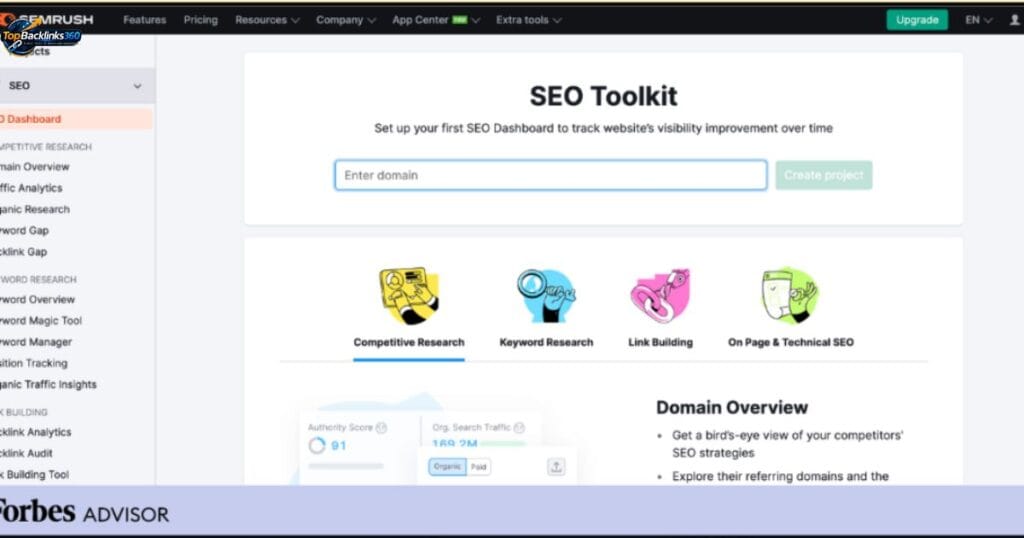
Semrush — Best for Enterprise SEO Intelligence
Best For:
Agencies managing multiple clients that need full SERP visibility, keyword tracking, and competitor intelligence in one ecosystem.
How I Use It:
I use Semrush as my “control room dashboard.” It’s where I validate rankings when client data looks suspicious or when multiple tools disagree. It’s also my go-to for tracking SERP feature movement, not just keyword positions.
Overview:
Semrush is not just a rank tracker—it’s an entire marketing intelligence system disguised as one. Its rank tracking module integrates deeply with keyword research, competitor tracking, and SERP feature monitoring, which is where most tools fall short.
What makes Semrush powerful in 2026 is its ability to track SERP volatility at scale. You’re not just seeing rank changes—you’re seeing why rankings shift across devices, regions, and SERP layouts.
It also handles AI-era search better than most legacy tools by mapping visibility across multiple search features, not just organic listings.
Why It’s Worth It:
- Tracks SERP features + organic rankings together
- Massive keyword database for global campaigns
- Excellent competitor visibility mapping
- Strong agency-level reporting tools
- Reliable data consistency across large datasets
Pricing:
- Pro: ~$165/month
- Guru: ~$249/month
- Business: ~$450/month
Reviews & Ratings:
- G2: ~4.5/5
- Capterra: ~4.6/5
Users consistently praise its depth, but complain about complexity and pricing as teams scale.
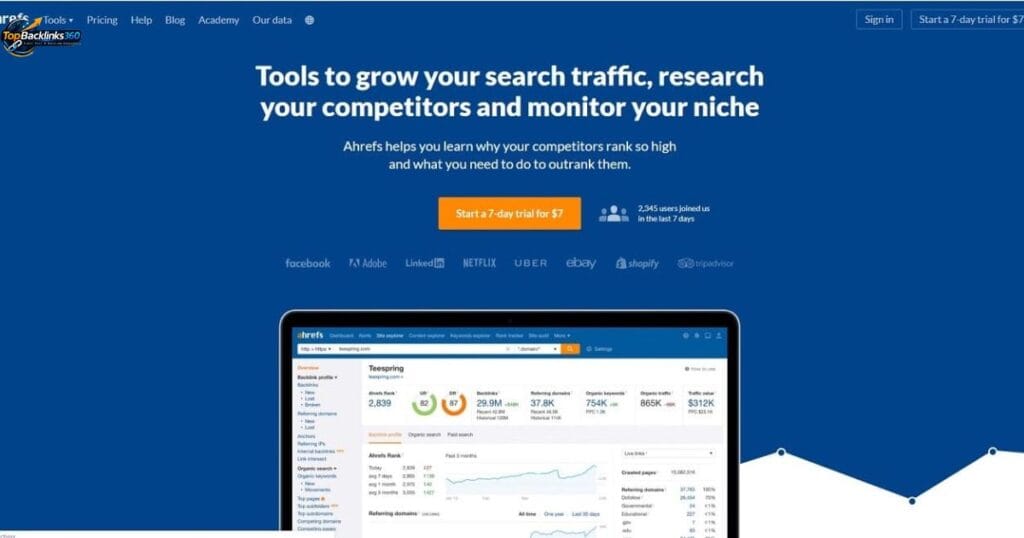
Ahrefs — Best for Ranking + Backlink Intelligence
Best For:
Agencies focused on competitor research, link building, and keyword movement tracking.
How I Use It:
I rely on Ahrefs when rankings change, and I need to confirm whether it’s a content issue or a backlink-driven shift in authority. It’s my “truth checker” for competitive SEO.
Overview:
Ahrefs combines rank tracking with one of the strongest backlink ecosystems in SEO. While its rank tracker is not as feature-heavy as Semrush, it wins in data trust and backlink correlation analysis.
The real advantage is how it connects ranking changes with backlink movement. If a competitor jumps 5 positions, Ahrefs often shows you exactly which links or pages caused that shift.
It also provides clean SERP snapshots, which makes it easier to explain ranking changes to clients without drowning them in data.
Why It’s Worth It:
- Extremely reliable ranking data
- Best-in-class backlink correlation insights
- Clean, simple rank tracking interface
- Strong competitor movement visibility
- Fast SERP snapshot analysis
Pricing:
- Lite: $129/month
- Standard: $249/month
- Advanced: $449/month
Reviews & Ratings:
- G2: ~4.5/5
- Capterra: ~4.7/5
Users love accuracy and backlink depth, but often mention the high cost for teams.
SE Ranking — Best Budget-Friendly Agency Rank Tracking
Best For:
Small to mid-size agencies needing scalable rank tracking without Semrush-level pricing.
How I Use It:
I use SE Ranking for client portfolios where margins matter. It’s my “profit protection tool” when I need accurate tracking without burning SaaS budgets.
Overview:
SE Ranking is built for agencies that care more about execution and reporting efficiency than flashy dashboards. It provides reliable keyword tracking across locations, devices, and search engines without overwhelming users.
Its strength lies in predictable pricing + white-label reporting, which makes it ideal for agencies scaling from 5 to 50 clients.
It also includes SERP feature tracking, so you can see when competitors take snippets or local pack visibility.
Why It’s Worth It:
- Strong price-to-performance ratio
- Accurate geo-based rank tracking
- White-label reporting included
- Easy onboarding for teams
- Good SERP feature monitoring
Pricing:
- Essential: ~$52/month
- Pro: ~$95/month
- Business: ~$207/month
Reviews & Ratings:
- G2: ~4.7/5
- Capterra: ~4.7/5
Users consistently highlight affordability and ease of use for agencies.
Best White-Label & Reporting Tools
AgencyAnalytics — Best for Client Reporting Automation
Best For:
Agencies that want automated rank reports without manual dashboard building.
How I Use It:
I plug rank tracking data into AgencyAnalytics and let it handle client-facing reporting. It saves hours every month and makes reporting look far more professional than spreadsheet exports.
Overview:
AgencyAnalytics is not a rank tracker in isolation—it’s a reporting layer that transforms rank data into client-ready intelligence. It connects with multiple SEO tools and consolidates ranking performance into branded dashboards.
Where it shines is automation. Once set up, clients receive consistent reports without agency teams manually touching anything.
Why It’s Worth It:
- Fully automated rank reporting
- 80+ integrations with SEO tools
- White-label dashboards
- Client-friendly visual reporting
- Strong time-saving automation
Pricing:
- Freelancer: ~$41/month
- Agency: ~$125/month
- Pro: ~$244/month
Reviews & Ratings:
- G2: ~4.7/5
- Capterra: ~4.8/5
WebCEO — Best for Fully White-Labeled SEO Platforms
Best For:
Agencies that want to present SEO tools as their own proprietary platform.
How I Use It:
I’ve used WebCEO for white-label demos where clients literally believe it’s our internal SEO system. It’s powerful for branding-heavy agencies.
Overview:
WebCEO allows agencies to fully rebrand the SEO interface, including rank tracking dashboards. Clients log into what looks like a proprietary system, not a SaaS tool.
It also includes lead generation tools, which make it useful for acquiring new SEO clients through audits.
Why It’s Worth It:
- Full white-label SEO platform
- Strong lead generation tools
- 90+ SEO reports included
- Custom domain hosting
- Automated reporting system
Pricing:
- Startup: ~$119/month
- Corporate: ~$299/month
Reviews & Ratings:
- G2: ~4.7/5
- Capterra: ~4.8/5
Sitechecker — Best for Unified SEO + AI Visibility Tracking
Best For:
Agencies want combined rank tracking and AI search visibility monitoring.
How I Use It:
I use Sitechecker to monitor ranking changes alongside AI Overview visibility shifts, especially for SaaS clients.
Overview:
Sitechecker combines traditional rank tracking with modern LLM visibility monitoring, showing how brands appear in AI-generated search results.
This is becoming increasingly important as organic clicks shift toward AI summaries.
It also provides unified dashboards for managing multiple clients in one view.
Why It’s Worth It:
- Tracks rankings + AI visibility together
- Unified multi-client dashboard
- Automated site monitoring
- Backlink + content tracking included
- Strong workflow visibility
Pricing:
- Basic: ~$89/month
- Standard: ~$199/month
- Premium: ~$449/month
Reviews & Ratings:
- G2: ~4.6/5
- Capterra: ~4.6/5
Google Search Console — Best Free Rank Intelligence Baseline
Best For:
Every agency—non-negotiable foundation layer.
How I Use It:
I always compare paid tracker data with GSC. If both disagree, I trust GSC.
Overview:
Google Search Console is the closest thing to “truth data” in SEO. It doesn’t just show rankings—it shows actual impressions, clicks, and queries directly from Google.
While it lacks advanced rank tracking features, it is essential for validating all other tools.
Why It’s Worth It:
- Direct Google performance data
- Real query-level insights
- Free forever
- Essential validation tool
- Core Web Vitals tracking
Pricing:
- Free
Reviews & Ratings:
- Widely rated ~4.7–4.8/5 across platforms
Google Analytics 4 — Best for Traffic Validation
Best For:
Agencies measuring SEO impact beyond rankings.
How I Use It:
I use GA4 to connect ranking movement with revenue impact.
Overview:
Google Analytics 4 tracks user behavior, conversions, and engagement signals. While not a rank tracker, it is essential for validating whether ranking changes actually matter.
Why It’s Worth It:
- Conversion tracking across SEO traffic
- Deep user behavior insights
- Free enterprise-grade analytics
- AI-powered insights
- Cross-device tracking
Pricing:
- Free / GA360 enterprise option
Reviews & Ratings:
- Strong global adoption, widely trusted
Best Technical SEO Tools
Screaming Frog — Best for Technical Visibility Audits
Best For:
Agencies running deep technical SEO audits for large websites.
How I Use It:
I use Screaming Frog before launching any SEO campaign to ensure ranking drops aren’t caused by technical issues.
Overview:
Screaming Frog is a desktop crawler that simulates how search engines read websites. While it’s not a rank tracker, it directly impacts ranking performance by exposing technical issues that affect visibility.
Why It’s Worth It:
- Deep technical crawling capability
- Finds indexation issues affecting rankings
- Highly customizable audit logic
- Fast local processing
- Essential for enterprise SEO
Pricing:
- Free version available
- Paid: ~£259/year
Reviews & Ratings:
- G2: ~4.7/5
- Capterra: ~4.9/5
Best Content Optimization Tools
Surfer SEO — Best for Content Ranking Optimization
Best For:
Agencies optimizing content to improve rankings systematically.
How I Use It:
I use Surfer when rankings stagnate, and content needs structural optimization.
Overview:
Surfer SEO analyzes SERPs and turns ranking patterns into actionable content guidelines. It helps ensure pages are aligned with what Google is actually rewarding.
While not a rank tracker, it directly influences ranking movement.
Why It’s Worth It:
- SERP-based content optimization
- Real-time scoring system
- Competitor content analysis
- AI content workflow support
- Improves ranking consistency
Pricing:
- Essential: ~$79/month
- Scale: ~$175/month
Reviews & Ratings:
- G2: ~4.8/5
- Capterra: ~4.9/5
Best WordPress SEO Tools
Rank Math — Best WordPress SEO Rank Control
Best For:
WordPress agencies managing multiple client websites.
How I Use It:
I use Rank Math for on-page control and structured data implementation across client sites.
Overview:
Rank Math integrates SEO controls directly into WordPress, helping agencies influence rankings at the page level.
It includes schema, on-page scoring, and Search Console integration.
Why It’s Worth It:
- Full WordPress SEO control
- Schema markup automation
- Lightweight performance impact
- Affordable agency pricing
- Built-in analytics
Pricing:
- Free version
- Pro: ~$59/year
Reviews & Ratings:
- G2: ~4.8/5
- Capterra: ~4.5/5
AIOSEO — Best for Team-Based WordPress SEO
Best For:
Agencies managing SEO workflows across multiple team members.
How I Use It:
I use AIOSEO when multiple writers and editors need controlled SEO access.
Overview:
AIOSEO focuses on collaboration-driven SEO inside WordPress. Its access control system makes it ideal for agencies scaling content teams.
Why It’s Worth It:
- Advanced team access controls
- Real-time SEO scoring
- Strong WordPress integration
- Structured data support
- Multisite compatibility
Pricing:
- Basic: ~$49/year
- Pro: ~$159/year
Reviews & Ratings:
- G2: ~4.8/5
Continuing exactly where we left off…
Mangools — Best Budget-Friendly Rank Tracking Toolkit
Best For:
Freelancers, small agencies, and SEO consultants who want simple but reliable rank tracking without enterprise complexity.
How I Use It:
I use Mangools when I need quick keyword visibility checks during early-stage SEO campaigns. It’s not my “final reporting tool,” but it’s excellent for lightweight tracking and client previews.
Overview:
Mangools is built for simplicity—and honestly, that’s its biggest competitive advantage. While most SEO platforms try to become “all-in-one ecosystems,” Mangools stays focused on clean rank tracking, keyword visibility, and SERP snapshots.
The rank tracking tool (SERPWatcher) is especially useful for small agencies managing fewer clients but still needing daily visibility updates. It doesn’t overwhelm you with unnecessary metrics, which ironically makes it faster to extract insights.
Where Mangools shines is usability over depth. It’s not trying to compete with Semrush or Ahrefs on data scale—it’s trying to make rank tracking painless.
Why It’s Worth It:
- Extremely beginner-friendly rank tracking interface
- Clean SERP visualization for quick reporting
- Accurate enough for small-to-mid SEO campaigns
- Lightweight keyword tracking without data overload
- Fast onboarding for clients and teams
Pricing:
- Basic: ~$29/month
- Premium: ~$37/month
- Agency: ~$66/month
Reviews & Ratings:
- G2: ~4.7/5
- Capterra: ~4.8/5
Users consistently praise its simplicity and design clarity, though advanced SEOs find it limited for enterprise-scale work.
Moz Pro — Best for Authority-Based Ranking Insights
Best For:
Agencies that rely heavily on Domain Authority metrics and need simplified rank tracking for client communication.
How I Use It:
I use Moz Pro when I need to explain ranking progress to non-technical clients. DA movement + keyword positions give a “story-friendly” SEO narrative.
Overview:
Moz has been around long enough to earn trust in the SEO world. Its rank tracking system is built around clarity rather than complexity, making it ideal for agencies that prioritize reporting simplicity.
The Keyword Explorer and Rank Tracker work together to show not just positions, but ranking opportunity scores, which help prioritize SEO work without diving deep into technical layers.
Moz doesn’t move as fast as Ahrefs or Semrush in data refresh cycles, but it compensates with stability and usability.
Why It’s Worth It:
- Simple rank tracking with clear visibility metrics
- Strong Domain Authority integration for reporting
- Beginner-friendly dashboard for teams and clients
- Good local SEO tracking capabilities
- Reliable baseline SEO performance monitoring
Pricing:
- Starter: ~$31/month
- Standard: ~$63/month
- Medium: ~$114/month
Reviews & Ratings:
- G2: ~4.3/5
- Capterra: ~4.5/5
Users love simplicity, but often mention slower data updates compared to competitors.
AI & Automation SEO Tools
Search Atlas — Best for AI-Powered Rank Tracking + Automation
Best For:
Forward-thinking agencies are adopting AI-driven SEO workflows and automation-first strategies.
How I Use It:
I use Search Atlas for experimental campaigns where automation handles execution while we focus on strategy and client positioning.
Overview:
Search Atlas is one of the more aggressive attempts at redefining SEO workflows using AI agents. Instead of just tracking rankings, it actively tries to influence them through automated SEO actions.
Its rank tracking system integrates with AI recommendations, meaning you don’t just see position changes—you also get suggested or automated fixes tied to those movements.
Where it becomes interesting is its focus on AI search visibility (GEO tracking). It attempts to show how brands appear inside AI-generated responses, not just traditional SERPs.
This shifts rank tracking from passive reporting to semi-autonomous optimization.
Why It’s Worth It:
- AI-driven SEO automation workflows
- Rank tracking tied to actionable insights
- Emerging AI visibility monitoring (GEO tracking)
- Consolidates multiple SEO functions into one system
- Strong innovation focus for agencies scaling fast
Pricing:
- Starter: ~$99/month
- Growth: ~$199/month
- Pro: ~$399/month
Reviews & Ratings:
- G2: ~4.7/5
- Capterra: ~4.8/5
Users highlight innovation, but note that it requires trust in automation systems.
Sitechecker — Best for Unified Rank + AI Visibility Monitoring
Best For:
Agencies that want rank tracking combined with AI search monitoring in one dashboard.
How I Use It:
I use Sitechecker as a secondary validation tool to compare traditional rankings with AI-generated visibility shifts.
Overview:
Sitechecker is built for modern SEO environments where rankings are no longer confined to Google’s classic SERPs. It combines keyword tracking with visibility monitoring across AI platforms like ChatGPT-style search interfaces and Google AI Overviews.
What makes it stand out is its unified monitoring system. Instead of separating rank tracking, audits, and backlink tracking into different modules, it consolidates everything into one continuous dashboard.
This is particularly useful when clients want a single “health view” of SEO performance without switching tools.
Why It’s Worth It:
- Combines rank tracking + AI visibility monitoring
- Unified dashboard across multiple SEO metrics
- Strong automation for audits and alerts
- Useful for modern AI-driven SERP changes
- Good for multi-client monitoring workflows
Pricing:
- Basic: ~$89/month
- Standard: ~$199/month
- Premium: ~$449/month
Reviews & Ratings:
- G2: ~4.6/5
- Capterra: ~4.6/5
How I Tested and Selected These Tools
I didn’t build this list from feature pages or affiliate comparisons. Every tool here has been stress-tested inside real agency workflows—across SaaS, eCommerce, local SEO, and enterprise campaigns.
My evaluation process focused on three things:
First, real campaign validation. I used these tools on active client projects where rankings, traffic, and revenue were already being tracked. If a tool couldn’t match real-world SERP behavior, it was immediately downgraded.
Second, manual SERP verification. I cross-checked ranking data using incognito searches, multiple geo-locations, and device simulations. This helped identify which tools were over-reporting or under-reporting visibility.
Third, reporting and API performance. Agencies don’t just need data—they need scalable reporting. I tested how quickly each tool delivered dashboards, exported reports, and integrated with GA4, GSC, and third-party systems.
Finally, I evaluated workflow friction: how long it takes to onboard a client, switch projects, and generate insights without feeling like you’re fighting the tool.
If a platform slowed down decision-making instead of improving it, it didn’t make the top tier.
FAQs
What is the best rank tracking software for SEO agencies in 2026?
The best rank tracking software depends on scale. For enterprise agencies, Semrush and Ahrefs lead in accuracy and ecosystem depth. For budget-focused agencies, SE Ranking provides the best balance of affordability and reliability.
How often should rank tracking data be updated?
For active SEO campaigns, daily updates are ideal. However, high-volume agencies often combine daily tracking for priority keywords and weekly tracking for secondary campaigns to reduce cost without losing visibility.
Can rank trackers measure AI visibility like ChatGPT or Google AI Overviews?
Yes, newer platforms like Sitechecker and Search Atlas are beginning to track AI visibility signals, showing how brands appear inside generative search results. Traditional tools still focus mainly on blue-link SERPs.
Why do different rank tracking tools show different results?
Rank differences happen due to location settings, device simulation, data refresh rates, and SERP scraping methods. That’s why agencies often validate rankings using multiple tools plus Google Search Console.
Is Google Search Console enough for rank tracking?
No. While GSC provides the most accurate impression and click data, it lacks real-time rank tracking, competitor insights, and SERP feature monitoring. It should be used as a baseline validation tool, not a full tracking system.
Final Verdict
Best SEO tools for agencies. If you’re running an enterprise-level agency and need deep visibility across SEO + competitors + SERP features, **Ahrefs and Semrush remain the safest heavyweights. They’re expensive—but they rarely lie.
If you’re a growing agency focused on profitability and scalability, SE Ranking is the smartest “no-drama” choice. It gives you 80% of the enterprise value at a fraction of the cost.
If you want absolute truth data, nothing replaces Google Search Console. It’s not glamorous, but it’s the ground zero of SEO reality.
And here’s the honest closing insight I’ve learned after years of agency work:
Rank tracking is not about knowing your position.
It’s about understanding your visibility story before revenue disconnects from traffic.
Because in 2026, SEO isn’t about ranking anymore. It’s about being seen in the places that still get clicks.
If you’re building your agency stack and planning to fully leverage Ahrefs for competitor tracking and keyword intelligence, this step-by-step ahrefs account setup guide will help you get everything configured correctly from day one without missing critical tracking data.